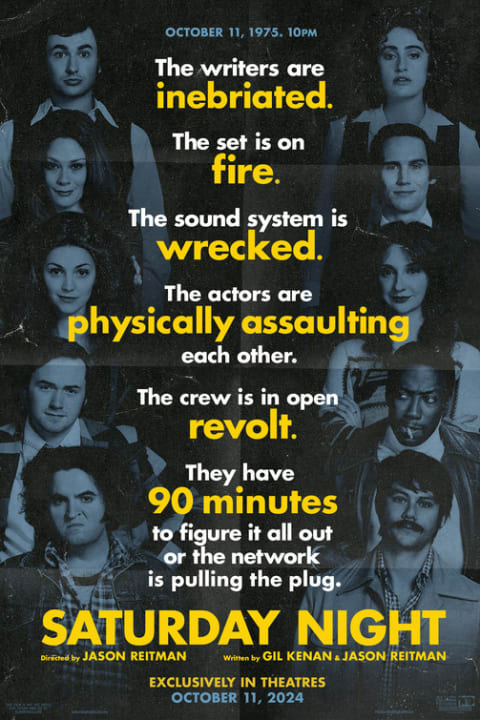
Saturday Night
Comedy Sony R 1h 49m Released Sep 27, 2024 Discussed 2024
Opening (limited)
$270,487
5 theaters
Per-theater average
$54,097
opening weekend
Domestic total
$9.5M
Worldwide total
$10.0M
95% domestic
RT critics
77%
RT audience
83%
+6 vs critics
Metacritic
60
Platform release: the opening figure is its limited debut in 5 theaters, not a wide-release weekend.
Where it turns up
Friday, September 27, 2024 Fourth weekend of September 2024
Expected 'Figure a pretty sexy PSA in the $45k to $50k range' Actual: $54.1K per screen
In the note
That would put them at around $1.7 or so for this weekend. Saturday Night - Went exclusive 5 runs with 2 in NY (Lincoln Sq, Alamo Brooklyn) and 3 in LA (Grove, Century City and Burbank), and it’s really good across the board.
Friday, October 4, 2024 First weekend of October 2024
Expected 'A decent psa in the low mid teens' Actual: ~$12.9K per screen
In the note
I'm not sure how deep this will go this weekend, but if it plays out normally, it should end up around $1.5 million or so for the weekend. Monster Summer - Went 1200 runs and there's very little going on here, maybe $500k for the weekend. Saturday Night - Expanded to 21 theaters and took 9 additional markets. There are some bright spots in the expansion markets like Austin and Chicago, and some bright spots where they expanded in NY and LA such as the Empire Times Sq and DTLA; but for the most part the expansion looks a little soft.
Friday, October 11, 2024 Second weekend of October 2024
In the note
This looks like a weekend of about $4 million on only about 1800 screens, but films like this are insanely hard to market, so that number is a pretty impressive achievement for Focus. Saturday Night - Finally went wide on 2300 screens and it’s doing what it's been doing the last couple of weeks.
Friday, November 1, 2024 First weekend of November 2024
In the note
As expected this is a super quiet weekend. Over the years Halloween has evolved from a day that gets dinged a little by Halloween activities to a day that’s pretty good when it falls on a weekday (especially for something scary), but it’s death for movies when it falls on a weekend. Since it was yesterday, the day was pretty good; however we still (stupidly) open films on Thursday, so unless you have a film where the Opening Day (Thursday) gross is just a detail, you look for other dates. Last year didn’t really have anything; usually it’s a Marvel or Disney film but they passed on it because when November sets up with Veterans Day on a Friday or Saturday (it was Saturday last year) you want those kids out of school on Friday, so they went there instead. But we’ll still end up a little behind last year (Priscilla, Radical, What Happens Later), maybe by 10% or a little more; but 10% at the level we’re talking about is only $5 million, so it’s not a lot of money to be made up. We’ll still be behind next week too, but then Glicked kicks in and it’s on for the rest of the year. I’ve spoken a lot about IP here, and there’s an IP issue that maybe we should talk about; it’s nothing new we just have to figure out how to leverage it better; Studio branding as IP, and how we can make it make sense to the consumer? Over the history of Theatrical, branding has played a huge role in getting consumers to the theaters, and when you attach a brand (that has stayed in a particular lane) to a film, the audience understands what they are buying and it’s additive to the IP equation every movie needs. Obviously the clear example is Disney; over the course of its 101 years, it never veered from the lane they started in. To take that one step farther, when they did make films that were outside of the lane they were in, they created other brands (Hollywood and Touchstone) to protect the core IP of their brand. In the heyday of those brands, especially Touchstone, they had their own IP value and normal moviegoing consumers knew what they meant. The reason I bring this up is that I’ve been hearing some new brand IP as I speak with my civilian friends about movies. The two names that keep coming up are A24 and Neon; and the fact that unaided IP recall is coming from civilian consumers in Wisconsin, Texas, Missouri, Tennessee, etc; not people in LA or NY, is interesting to me. When I was talking about Longlegs a couple of months ago the ‘oh, it’s Neon’ response would come up, same with films like Iron Claw and A24. It’s as if these two studios have built themselves a lane that consumers not only understand, but they see it as an additive part of the equation that gets them to the theater. Of course, both of these studios have won Best Picture Oscars recently, so the fact that a consumer thinks of these two brand IP’s as a good thing, Best Picture Oscars might have something to do with the glow. Kind of the opposite of someone saying 'it's a Netflix movie', but that's a brand conversation for another time. But for the most part, both of these studios have stayed in a lane, and that’s something we should consider going forward as we think of other studios and their labels. Look at what is going on with a couple of the family brands currently at Universal. The homegrown brand, Illumination, is a top tier brand now but it didn’t used to be. After the success of Despicable Me, Hop and then The Lorax, they started leveraging the Minions as the Illumination ambassadors around the time of Despicable Me 2, and started all the marketing materials with them. On the other hand, Dreamworks Animation was a major IP back when it was a standalone company, and there was a time when you could speak of the IP in the same breath you could speak about Pixar. But it's been dormant for quite a while, and as the last couple of non sequel DWA films have showed us the brand doesn't connect films automatically with Family audiences. Had something like The Wild Robot had brand IP (like Disney, Pixar or Illumination) it probably would have opened to a much higher gross than it did with the DWA brand. So what does this mean going forward? Well, if we want to do something about it, it all comes down to two issues; the (underappreciated) folks in Business Affairs and the culture of Studio fiefdoms. Almost every studio has brands in their quivers; Sony has Screen Gems, Tri-Star, Sony Classics, Amazon has MGM, UA and Orion and it's pretty much the same all over town. Since one of the beautiful aspects of the way our sector has evolved over the last 10 years is the game of 'chutes and ladders', where a film can be made as a streamer but gets promoted to theatrical (or vice versa), what if we take that idea to brands within studios? Let's take a film like Saturday Night, which was released in 3 tiers under the Columbia brand.